
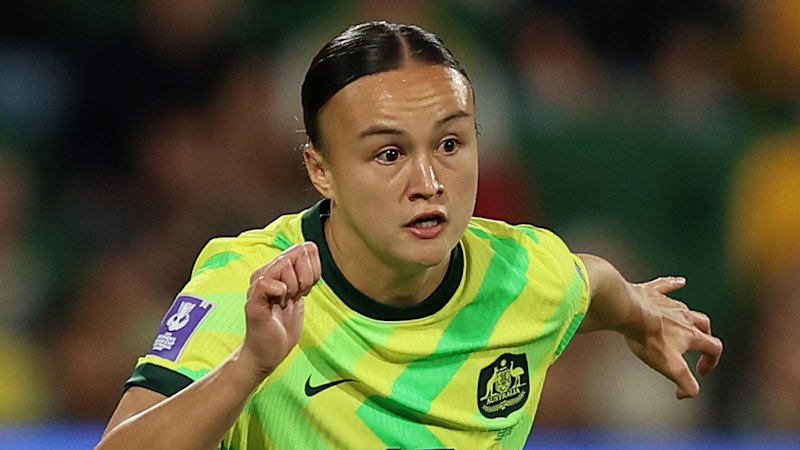
Three years ago, Amy Sayer was sitting in a California dormitory in the early hours of the morning, watching Australia fall in love with the Matildas on a laptop screen. The rest of the country was gripped by Matildas fever. She was on the outer, having missed the cut for the 2023 home World Cup.
Sayer had been named in the extended squad but heartbreakingly missed out on Australia's 2023 Women's World Cup tournament. She'd been told to stand by as injury cover, waiting for a phone call that never came. The team's opening match against Ireland was looming. At 8pm on the eve of that game, she texted the team manager asking to be sent back to Stanford University, where she was studying human biology and philosophy.
"It was bittersweet," she recalled. She'd earned her place at the elite American university with an ATAR of 99.25 when she sat her HSC in Sydney in 2019, determined to balance scholarship study with the pursuit of elite football. But timing, injury, and selection choices had conspired against her. While millions of Australians watched the Matildas make history, Sayer studied remotely and watched on a screen.
A second setback followed. An ACL injury sustained in April 2024 saw her miss the chance to head to the 2024 Olympic Games. The injury happened just as she was building momentum, just as another major tournament loomed. For many players, such a sequence of disappointments might define a career. But Sayer approached her rehabilitation with the same methodical focus she'd brought to her studies. When she returned, she was different.
In June 2025, Sayer scored two goals in her first start in 549 days, a signal that something had shifted. She'd worked her way back not just to fitness, but to a higher level of play. She's now 24, a graduate, and plays professionally for top Swedish club Malmö FF. This Asian Cup, held at home, represents something entirely different: the moment she finally gets to feel what she watched on that laptop three years ago.
In the opening stages of the tournament, Sayer has looked capable of doing something special. She scored the team's first goal in a long range effort from the right-hand side of the field in Australia's 4-0 victory over Iran, an opening goal in her first start at a major tournament that felt overdue. She's made appearances off the bench and started once, contributions that hint at the player she might become for Australia.
The question now is opportunity. Coach Joe Montemurro faces a semi-final against China that will require breaking down a defensive structure. China are the reigning Asian Cup champions, disciplined and organised. If Australia needs to unlock a stubborn defence, Sayer represents precisely the kind of attacking midfield creativity that could open doors. She's shown in club football that she can operate at the highest level. At Stanford and now at Malmö, she's demonstrated that individual excellence emerges when talent meets timing.
What Sayer did next would define more than her season. It will define whether she becomes the player her talent has always suggested she could be.