
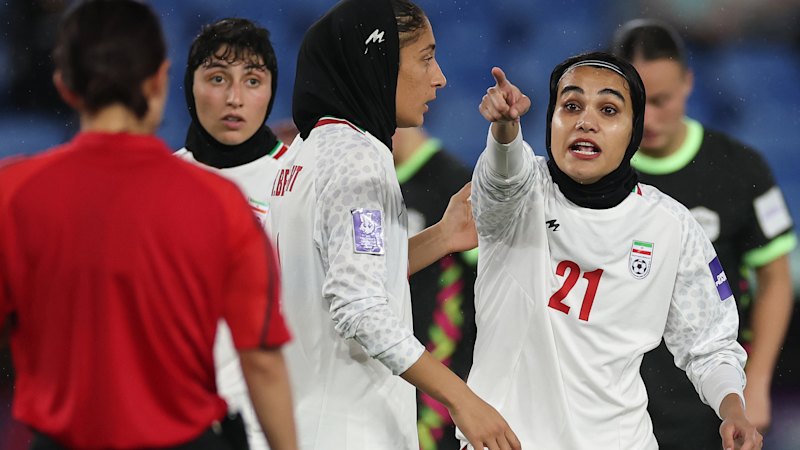
From Tokyo: On the Gold Coast on a Monday night in early March, six women made a choice that transformed their lives in seconds. During the tournament, the squad drew attention after remaining silent during Iran's national anthem prior to its opening match against South Korea, a decision that triggered criticism from state media.
For athletes representing an Islamic Republic that restricts women's freedoms at every turn, silence itself becomes a form of defiance. Iranian Australian human rights advocate Tina Kordrostami told CNN Sports that the refusal to sing the anthem before the South Korea match took "extraordinary courage." In Iran, where phones are monitored and public speech is restricted, one moment of quiet resistance carries the weight of everything unsaid.
The backdrop to this moment mattered enormously. They had arrived to play in the Asian Women's Cup before the United States and Israel began striking Iran on Feb. 28, and were knocked out of the tournament over the weekend. In a country at war, a sports team becomes more than athletes. It becomes a symbol, and symbols in authoritarian regimes carry consequences.
Global football players' union FIFPRO said earlier on Monday that there were serious concerns for the welfare of the team as they prepared to return home after being labelled "wartime traitors". State television at home had branded them with language typically reserved for the worst betrayals. The threat was not abstract; it was broadcast on every screen in Iran.
What happened next unfolded over a week of extraordinary tension. Early Tuesday, police officers transported five of the women from their hotel in Gold Coast, Australia, "to a safe location" after they made asylum requests. There, they met with Home Affairs Minister Tony Burke and the processing of their humanitarian visas was finalised, the minister told reporters in Brisbane. By Wednesday, the total had grown. An additional player and a member of the team's support staff had received humanitarian visas, after five players were earlier granted asylum over concerns for their safety should they return to Iran. The pair joined five other team members granted humanitarian visas a day prior.
The decision to stay in Australia came loaded with the kind of complexity that cannot be resolved by any single choice. These were women who had families in Iran, who had salary income, who belonged to a community. "I don't want to begin to imagine how difficult that decision is for each of the individual women, but certainly last night it was joy, it was relief," said Burke, who posted photos to social media of the women smiling and clapping as he signed documents.
But the situation revealed something else: the extraordinary pressure women athletes face when personal survival and political allegiance become inseparable. One of the seven members of the Iranian soccer team granted refuge in Australia has changed her mind, forcing Australian officials to hurriedly move the other six women after she divulged their secret location to the Iranian embassy. Home Affairs Minister Tony Burke told Parliament Wednesday that the woman, who took up an offer of a visa on Tuesday night, had consulted team members who had already left the country and requested to join them. "Unfortunately, in making that decision, she'd been advised by her teammates and coach to contact the Iranian embassy and to get collected," Burke said.
Sports journalist Raha Pourbakhsh told CNN Sports that the families of three of those five players had been threatened. These were not abstract risks. These were real families in a country at war, leverage in the hands of a regime that excels at making decisions difficult.
The international response brought its own complications. US President Donald Trump, who is currently waging war on Iran alongside ally Israel, said that he had spoken to Australian Prime Minister Anthony Albanese about the "delicate situation" faced by the team. Earlier, Trump had called on Albanese to "give ASYLUM" to the team, warning the Australian leader that he would be making a "terrible humanitarian mistake" if he allowed the team's players to be "forced back to Iran, where they will most likely be killed". Iran's football federation said Trump's comments were "baseless and unlawful" and urged global football authorities to intervene.
What Australian observers often miss about such situations is that asylum is not always a straightforward refuge. For these athletes, staying in Australia means building lives thousands of kilometres from everything and everyone they know. It means uncertainty about whether families will face reprisal. It means starting again in a country where their professional football careers have no guaranteed continuation. It is survival, not escape; pragmatism, not victory.
The broader story extends beyond these six women. The remaining squad and staff members flew out of Sydney to Kuala Lumpur on Tuesday evening in emotional scenes and arrived in Malaysia early Wednesday morning. For those who returned, the weight of that choice remains: returning to a country at war, a regime scrutinising their every action, uncertain of what awaits them at home.
In a world where states use sport as a tool for control, where an anthem can become a political trap, and where silence itself becomes an act of defiance, the choice these six women made reflects something deeper than individual courage. It reflects the impossible position of women athletes in authoritarian states; it reveals how geopolitical conflict reaches into the personal decisions of ordinary people; and it shows why, for some, the only real choice is to step away from home entirely.
The women granted asylum were happy for their names and pictures to be published, he said. In allowing their identities to become public, they have chosen not just refuge but visibility. In a country that sought to silence them, they have chosen to be seen.