
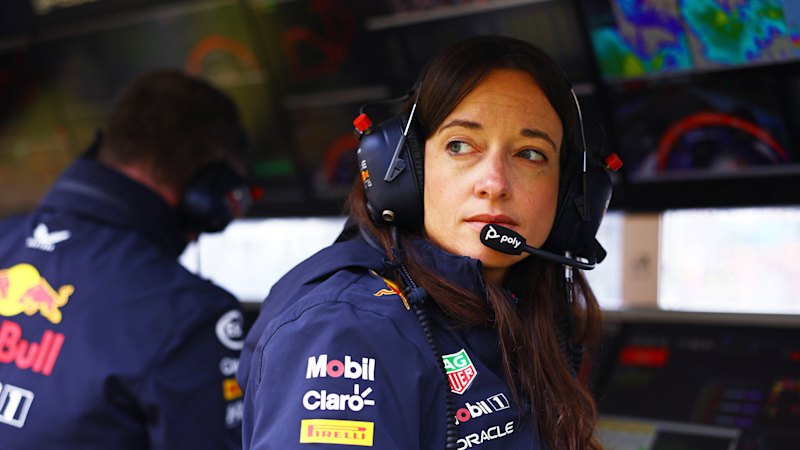
When Max Verstappen crossed the line to win the 2022 Hungarian Grand Prix, he did so from a starting position of tenth on the grid, in deteriorating conditions, on a tyre choice almost nobody else had made. In the post-race debrief, he credited one person above all: Hannah Schmitz, Red Bull's principal strategy engineer, whom he described as "insanely calm".
That description has followed Schmitz through the paddock ever since, and it is not hard to see why. Her job is to read weather patterns, tyre behaviour, pit stop windows, and competitor moves, then make consequential calls in under thirty seconds when a race turns on its head. In Budapest four years ago, she saw an opportunity where others saw only risk, and she took it.
Now, ahead of the 2026 Australian Grand Prix at Albert Park, Schmitz is receiving a different kind of recognition. Turn 6 of the Melbourne street circuit will be named in her honour, alongside Laura Mueller, who made history as the first full-time female race engineer in Formula 1. The dedication is timed for International Women's Day on March 8, marking the first occasion corners at the circuit have been named for women in the sport.
Schmitz, speaking over Zoom ahead of the event, said the honour caught her off guard. "It's not something I ever expected," she said, though she welcomed it as recognition of women's contributions to a sport that has historically been dominated by men at every level of its technical and operational structure.
Her path to one of the most demanding roles in motorsport was shaped early. A Cambridge master's degree in mechanical engineering gave her the technical foundation, but Schmitz traces her instinct for problem-solving further back, to childhood games of Cluedo and chess. She grew up in a sport-loving household and came to Formula 1 through genuine curiosity about its strategic depth rather than a lifelong obsession with the cars themselves.
"I always liked organising everybody and making sure everyone knew what they were doing," she said, with some amusement. It is a quality that translates well when a safety car is deployed with ten laps to go and every team in the paddock is recalculating at once.
The relationship Schmitz has built with Verstappen over years of working together is one she describes in terms of trust above all else. "There's a lot of trust there," she said. "I think that's really important from a strategy point of view, that the drivers can trust that you're going to be making the best decisions, and that you can also quite openly discuss things before a race." For a driver of Verstappen's calibre, that kind of open dialogue before a race weekend is not a luxury; it is part of how championships are built.
Red Bull arrives at Albert Park facing questions beyond the purely sporting. The team lost celebrated designer Adrian Newey in 2024, who subsequently joined Aston Martin. Longtime team principal Christian Horner was abruptly dismissed in 2025 and replaced by Laurent Mekies, more than a year after allegations of misconduct toward a team employee were made against him and subsequently dismissed following an internal investigation. Helmut Marko, the team's long-serving motorsport advisor, also stepped down within months of Horner's departure. When asked how the team was adapting to the upheaval, Red Bull's communications staff politely declined to let the question proceed.
What Schmitz is willing to discuss is the future of women in the sport. As a mother to two daughters, and in a week when she is reflecting on the legacy of her grandmother Jackie, who passed away recently, the question carries personal weight. Jackie fought against community expectations that she leave school at fourteen to work in a cotton mill. That resistance to imposed limits, Schmitz said, runs through the women in her family.
"If someone tells you that you can't do something or that's not really an appropriate job, it's just something we tend to ignore and do anyway," she said.
On the prospect of a female Formula 1 driver within the decade, Schmitz is hopeful but clear-eyed. She acknowledges the playing field is not level, and that any woman who makes it to the grid will carry a disproportionate burden of expectation and scrutiny. She points to programmes like the F1 Academy as genuine steps toward creating more pathways into the sport. "I really hope so," she said. "I think it is a sport where gender shouldn't really impact your ability."
The naming of Turn 6 at Albert Park will not, on its own, change the gender ratio in Formula 1 engineering or on the grid. But it marks something real: a sport beginning to see itself clearly enough to honour contributions it might once have taken for granted. For Schmitz, who has spent her career focused on the next decision rather than the last accolade, that is probably recognition enough.