
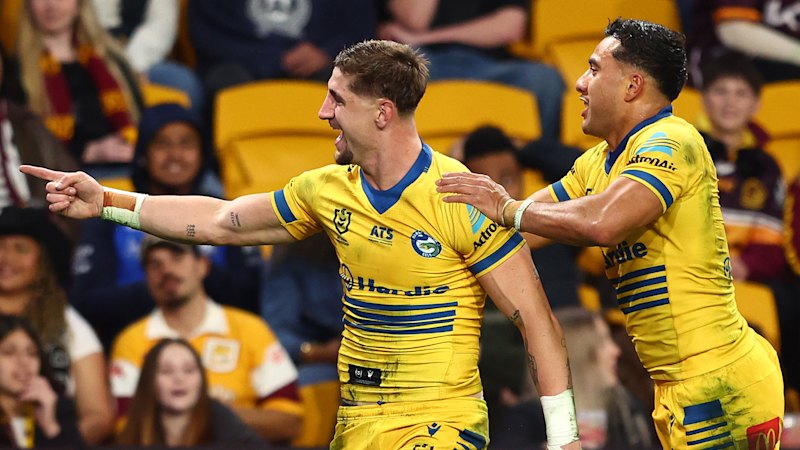
Here's a stat that might surprise you: the legal costs alone in the Zac Lomax contract dispute are expected to reach up to $400,000 per side before a single ball is thrown in the 2026 NRL season. That figure, remarkable in any context, tells you something important about what is really at stake in courtroom 8A of the Supreme Court in Sydney when Justice Francois Kunc opens proceedings on Monday.
This is no longer simply a story about one footballer's career choices. It is a test case for how rugby league manages player contracts, restraint-of-trade clauses, and the boundaries of institutional power in a salary-cap sport. The outcome will be felt well beyond Parramatta and Melbourne.
The basic facts are now widely known. Lomax, a 26-year-old NSW Blues representative, accepted the Eels' release terms to join R360, a proposed breakaway competition promising substantial American-based earnings. Within two weeks of signing those terms, R360 postponed its inaugural season until 2028. Many observers believe the competition will never launch at all. Lomax, who had purchased a $4 million oceanside property at Barrack Point, suddenly found himself without a competition to play in and without the income to justify the move.
Melbourne entered the picture and attempted to sign Lomax without Parramatta's consent, which is where the restraint clause becomes critical. Lomax had agreed he could not return to the NRL before October 31, 2028 without the Eels' written approval. Whether that clause is enforceable, whether it was negotiated in good faith, and whether subsequent conduct by either party altered its legal standing are precisely the questions Justice Kunc must resolve, according to reporting by the Sydney Morning Herald.
Parramatta chairman Matthew Beach, addressing roughly 100 club members at the Eels' Kellyville headquarters in western Sydney, was unambiguous about the club's position. "We don't apologise for being in court, because we need to stick up for what's right for our club," Beach told the assembled members. The remarks drew loud applause, which is itself revealing: the Eels have clearly won the public relations contest among their own supporters, even if the legal contest remains entirely open.
The settlement arithmetic is worth examining. Melbourne offered $100,000, then $200,000, then a final figure of $300,000 including a $211,000 salary cap component tied to the wage of Ryan Matterson. Parramatta rejected all three. For context, when the NRL market last placed a price on comparable player movements, the Bulldogs paid the Broncos $500,000 four years ago for uncapped teenager Karl Oloapu. The Tigers received $165,000 for Lachlan Galvin last year. And just last week, the Warriors agreed to release NSW Origin forward Mitchell Barnett on compassionate grounds, demanding, in the words of chief executive Cameron George, compensation "in the form of a player or two."
Parramatta's position was that Lomax could be exchanged for Storm players Xavier Coates, Stefano Utoikamanu, or Jack Howarth, or alternatively have the remainder of Matterson's contract paid out. Given Melbourne's roster had already contracted following the departures of Ryan Papenhuyzen, Nelson Asofa-Solomona, and Jonah Pezet, plus the medical unavailability of Eli Katoa, it is not difficult to see why the Storm found those terms unacceptable. Agreement was never likely.
The case has drawn in more than the two clubs. The NRL attempted to broker a resolution and failed. Parramatta has now dragged the governing body into proceedings, alleging the NRL sided with Melbourne during negotiations. One particularly striking allegation is that Melbourne's chief executive asked the NRL to apply a "blow torch" to the Eels to secure a favourable outcome. Whether or not that allegation is sustained in evidence, its airing in open court is damaging to the sport's institutional credibility.
Beyond the scoreboard, the real story here is the tension between two legitimate competing interests. Players in any professional sport have a reasonable expectation that their career options will not be permanently constrained by contractual clauses negotiated under circumstances that subsequently changed dramatically. Lomax did not abandon the NRL for a rival domestic club out of self-interest alone; he left for what appeared, at the time, to be a genuinely separate competition. When that competition collapsed, the question of whether a restraint clause should still bind him in full is not as straightforward as the Eels' applause-line suggests.
At the same time, clubs investing in player development and roster construction have a legitimate interest in certainty. If a player can accept release terms, see those terms rendered moot by external events, and then immediately sign with a direct competitor, the value of contractual agreements across the entire employment framework is weakened. The Eels' argument is not simply about Lomax; it is about the integrity of every contract in the competition.
Melbourne's counsel, Adam Casselden, is one of the country's most experienced silks, having previously represented Israel Folau in his dispute with Rugby Australia. Parramatta is represented by senior counsel Arthur Moses. The quality of legal representation on both sides confirms that neither party is treating this as a routine employment dispute.
Lomax himself sits in an uncomfortable position. He has been without income for months, has no team to train with, and a property purchase premised on earnings that never arrived. People close to him say the limbo has been difficult. Even a legal victory is unlikely to fully restore a reputation that has taken real damage in the court of public opinion.
When you dig into the data on NRL player movement disputes, genuine test cases of this magnitude are rare. The precedent Justice Kunc sets, whatever it is, will shape how clubs, players, and agents approach contract negotiations for years. That makes Monday's proceedings consequential well beyond the opening-round clash between Parramatta and Melbourne on Thursday night, though that match will carry its own charged atmosphere regardless of what the court decides.
Reasonable people can disagree about where the line sits between a club's right to protect its contractual position and a player's right to resume a career derailed by circumstances outside his control. What the Lomax case makes plain is that the current framework for managing such disputes in Australian rugby league is under serious strain, and a Supreme Court judgment may be the only thing capable of clarifying it.